
UDS Hosts 22nd Inaugural Lecture on Transforming Ghana’s Organic Food System
The University for Development Studies (UDS) has held its 22nd Inaugural Lecture, with Professor Abdul Halim Abubakari delivering a thought-provoking presentation on “Transforming Ghana’s Organic Food System through Biochar-Enriched Compost Innovations: Circular Economy Pathways for Climate Resilience and Sustainable Development.”
The lecture, held at the Dr. Andani Andani Academic Board Chamber on the Tamale Campus of the University, attracted a distinguished and diverse audience drawn from all walks of life. In attendance were academics, industry players, policymakers, traditional rulers, civil society actors, students, and old students from senior high schools in Tamale. Also present were old students of Ghana Senior High School (GHANASCO), Prof. Abubakari’s alma mater, who turned out in significant numbers to support their distinguished colleague.
The event was chaired by the Vice-Chancellor of UDS, Professor Seidu Al-hassan, who described Prof. Abubakari as a scholar whose work exemplifies the founding philosophy of the University for Development Studies.
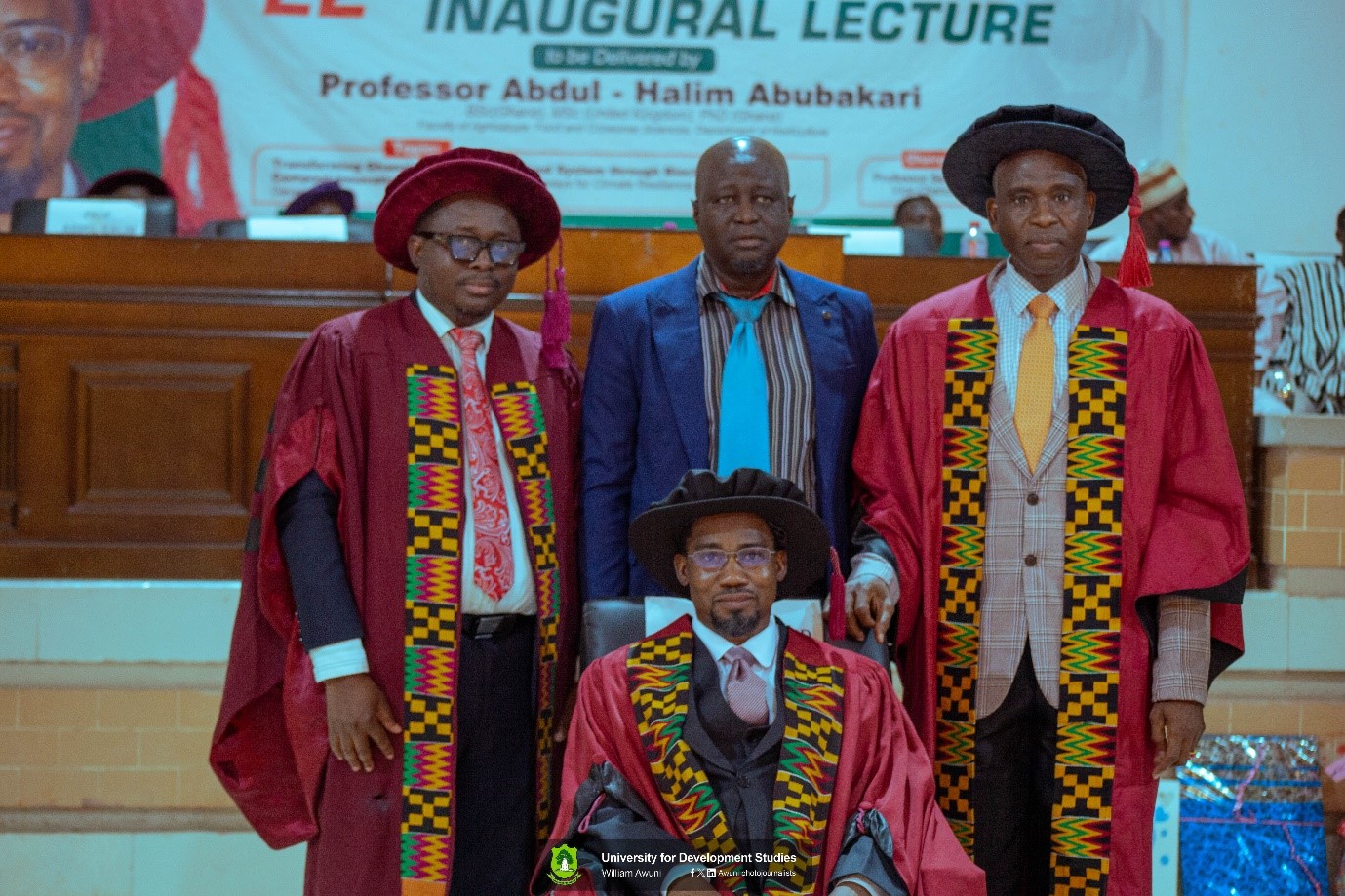
“Professor Abdul Halim Abubakari represents the very best of what UDS stands for, rigorous scholarship that is deeply rooted in community needs and deliberately oriented towards solving real-life development problems,” the Vice-Chancellor said.
He added that Prof. Abubakari’s work demonstrates how universities can move beyond theory to produce innovations that respond directly to climate change, food insecurity and sustainable livelihoods, particularly in northern Ghana and similar contexts.
In his lecture, Prof. Abubakari explained that the presentation was not merely an academic exercise, but an invitation to the academic community, civil society organisations, policymakers and development practitioners to reflect on how science can be more deliberately aligned with society’s most pressing challenges.
“This lecture represents nearly two decades of scientific inquiry, applied research and sustained engagement with farmers, municipal authorities, students, NGOs and state institutions,” he said. “It is inspired by UDS’ unique mandate of community-centred, problem-solving scholarship.”
He argued that organic agriculture is not a new concept, stressing that it is largely a response to disruptions caused by industrial agriculture.
“Before synthetic fertilisers and pesticides, farming systems were inherently circular, linking soil, crops, livestock, waste and human livelihoods in regenerative cycles,” Prof. Abubakari noted.
“Today, organic agriculture has evolved beyond the narrow idea of ‘chemical-free farming’ and has become central to broader debates on food system transformation, agroecology, climate resilience and circular economies, debates in which scholars and institutions must play a leading role.”
Urban Food Systems Under Pressure
Highlighting Ghana’s urban challenges, Prof. Abubakari pointed out that rapid urbanisation, nutrient-depleted soils, rising organic waste, food safety concerns and heavy dependence on imported fertilisers are placing enormous pressure on urban food systems.
However, he stressed that cities also generate large volumes of organic waste from households, markets, agro-processing facilities and sawmills. “Our research demonstrates that these wastes are not liabilities; they are resources,” he stated.
Biochar-Enriched Compost as a Game Changer
At the core of the lecture was the scientific validation of biochar-enriched compost (BeC) as a transformational solution for sustainable agriculture and climate resilience.
According to Prof. Abubakari, rigorous laboratory experiments, controlled field trials and farmer-managed plots have shown that BeC significantly improves soil structure and water-holding capacity, enhances nutrient retention, and reduces yield gaps. The research further demonstrates that BeC reduces greenhouse gas emissions during composting and in soils, immobilises heavy metals in polluted urban soils, and can increase crop yields by up to 90 percent in degraded urban environments.
“Biochar-enriched compost provides a low-cost, locally produced alternative to imported fertilisers and greenhouse media,” he explained. “More importantly, it closes the loop between waste, soil, food and climate, the very essence of a circular economy.”
Call to Academia and Policymakers
Prof. Abubakari emphasised that the findings underline the importance of long-term, cumulative research, where incremental discoveries converge into system-changing innovations.
“For the academic community, this work illustrates the value of patience, persistence and partnership with communities,” he said. “When research is grounded in local realities, it can deliver solutions with national and global relevance.”
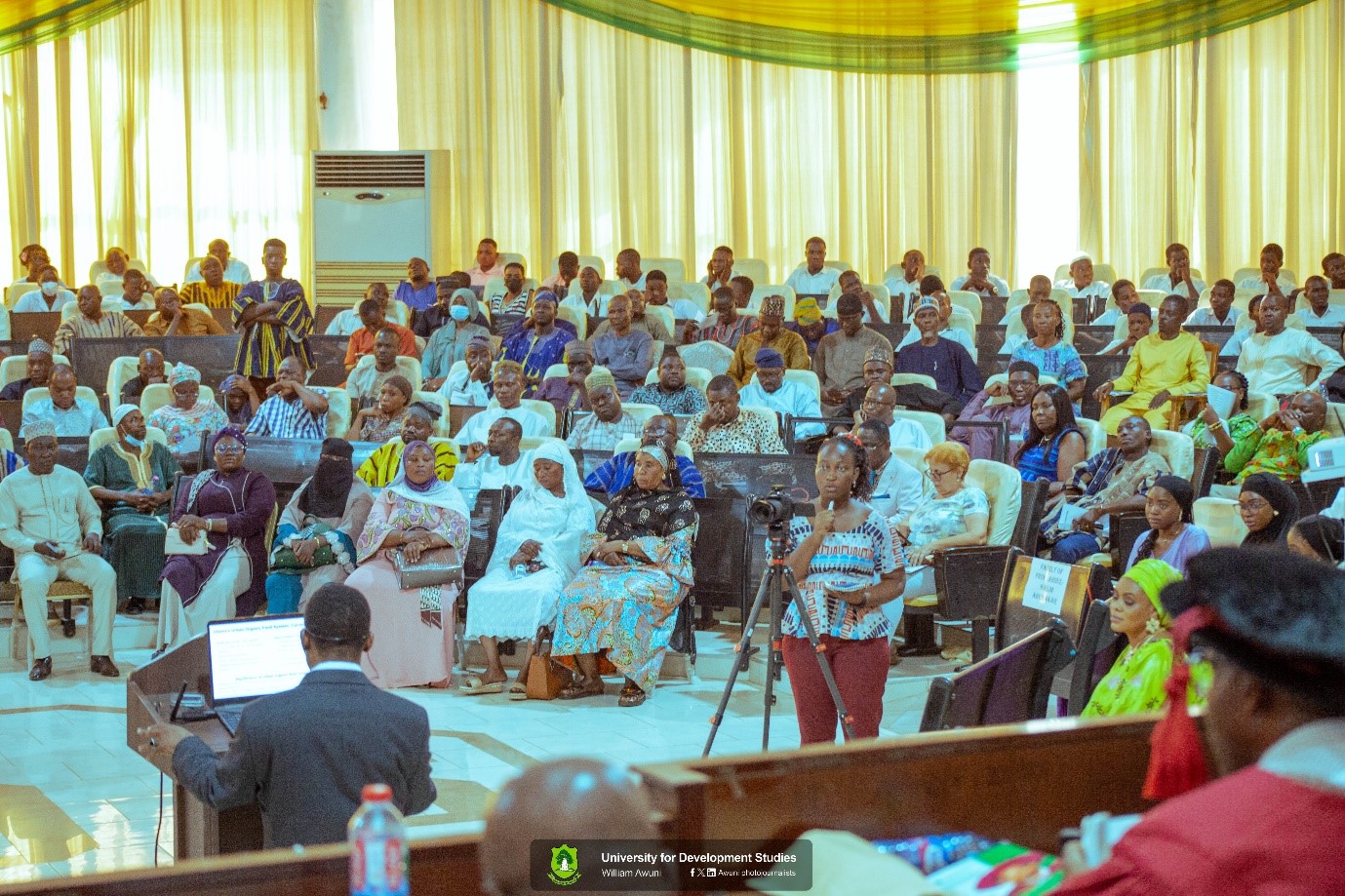
The lecture reinforced UDS’ reputation as a leading institution in community-centred research and development-oriented scholarship, while also positioning biochar-enriched compost as a viable pathway for transforming Ghana’s organic food systems in the face of climate change and sustainability challenges.
Story by: Abdul Hayi Moomen
(UDS Media)